The Association Builder defines the related-object paths used by a portal and distinguishes relationships shown to users from relationships used to determine access.
Build the association graph
- Open the correct object configuration in https://app.woodsportal.com.
- Open Associations.
- Add the required root objects.
- Connect child objects along the relationship paths the portal needs.
- Inspect each association forest and confirm that the source and target objects are correct.
- Remove an eligible leaf when a relationship is no longer required.
- Save the graph and monitor any background synchronization job.
Configure labels
- Use display labels for relationships that portal users should see.
- Use access labels for associations that authorize record access.
- Confirm the matching HubSpot association labels before relying on them in the portal.
- Do not assume that every visible association also grants access.
Graph rules
- The Contact appears once as the identity root.
- The canonical graph supports one primary mediator and multiple portal roots.
- Administrative graph expansion is capped at 48 instances.
- Opening a legacy graph does not migrate it automatically. Use Sync graph when the migration banner indicates it is required.
Troubleshooting
- If a path is missing, confirm the HubSpot association and the configured graph edge.
- If a legacy configuration is shown, run the explicit synchronization and wait for the job result.
- If a record is visible but inaccessible, review the access association label, user scope, and object permissions.
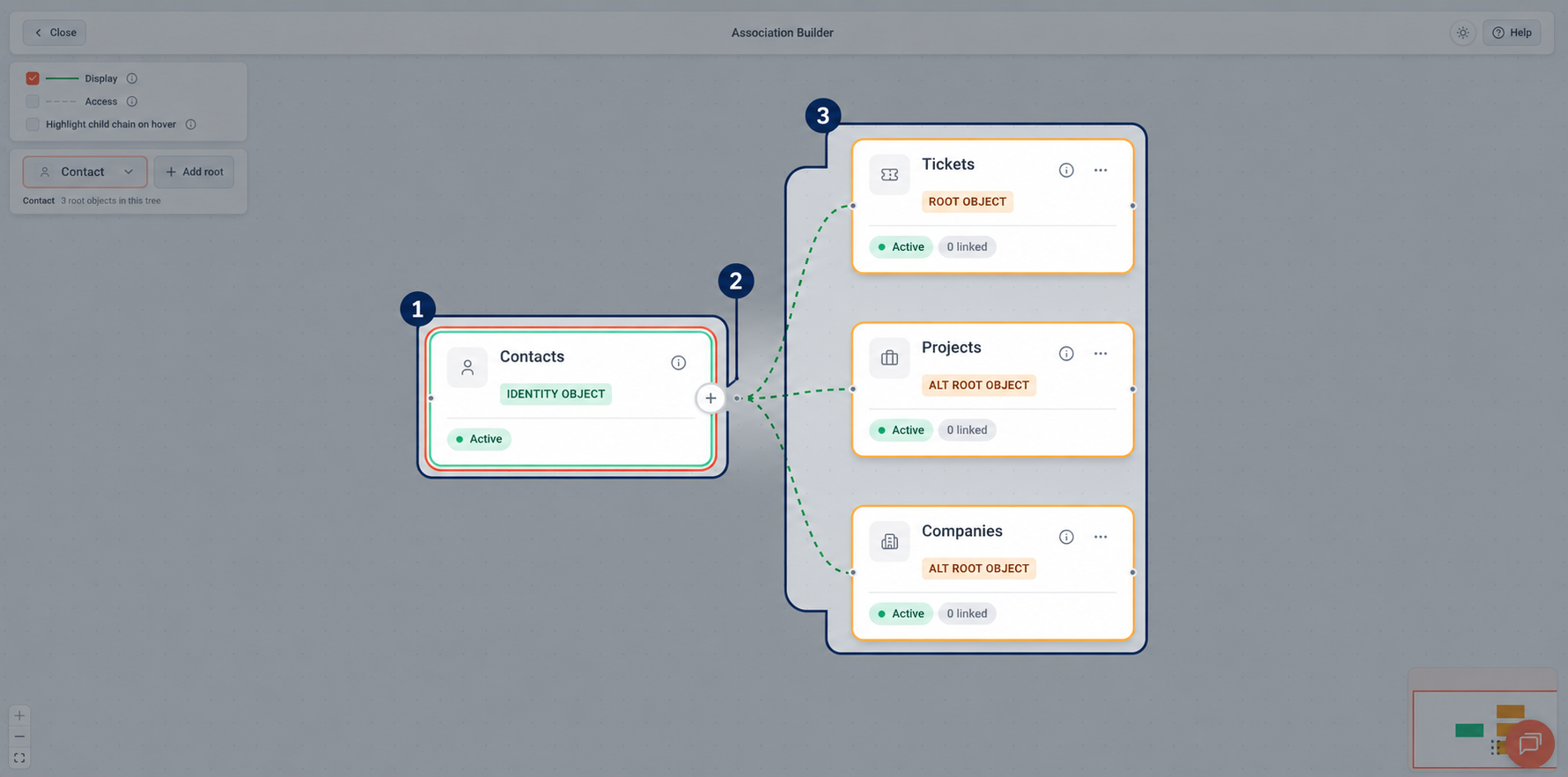
Figure: Map the contact identity object to related HubSpot objects in the Association Builder.
.png)